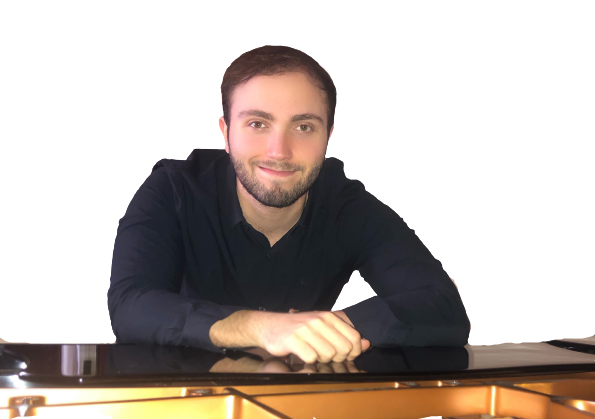
Michelangelo Salamone

A science-based approach integrating piano methodology,
performance psychology, and neuroscience research.
37 video lessons · 5 modules · lifetime access · learn at your own pace
Full course access · €97 · Lifetime license
The Problem
The conditions are different. The stakes are different. The cognitive and psychological demands are different. Yet most pianists prepare for all of these using the same undifferentiated approach.
Most practice sessions repeat what is already known. Neuroscience is clear: repetition without deliberate correction encodes errors, not solutions.
Without understanding how motor learning, memory consolidation, and attention interact, even disciplined practice produces inconsistent results.
Performance psychology has documented this for decades. Practice-room confidence and stage confidence are two distinct skills. Most pianists train only one.
The Method
How the brain acquires, consolidates, and retrieves motor and cognitive skills. Understanding these mechanisms transforms how you structure every practice session.
The mental and psychological demands of performing under pressure. From competition anxiety to stage confidence — trained systematically, not left to chance.
The biomechanical and productivity principles behind piano progress. Motor pattern acquisition, movement economy, and the structural conditions that allow technical growth to become permanent.
The Curriculum
37 on-demand video lessons taught by Michelangelo Salamone and Heather O'Donnell.
How errors become encoded in motor programs (Ericsson, 1993)
The interference effect: what happens when you practice mistakes
Deliberate practice protocols that prevent error consolidation
The role of spacing and interleaving in long-term retention
The principle of proximal-to-distal force transmission
Tension patterns that limit velocity and dynamic range
Biomechanical principles for identifying and retraining inefficient movement patterns
Injury prevention and sustainable technique
Declarative vs. procedural memory: what you think you know vs. what your hands know
Sleep, consolidation windows, and optimal practice timing
The pressure simulation protocol
Attentional focus strategies during performance (Wulf, 2013)
Why performance anxiety is not a psychological weakness
The autonomic nervous system response in performance contexts
Exposure-based training and systematic desensitization
Cognitive reappraisal strategies validated by performance research
Variable vs. blocked practice: what the research shows
The role of mental practice and motor imagery (Pascual-Leone, 1995)
How fatigue affects motor encoding
Optimizing practice session structure for maximum retention
Competition psychology: the difference between performing to win and performing well
Audition-specific preparation: managing uncertainty and selection pressure
Concert programming as cognitive design
The pre-performance protocol: evidence-based preparation routines
From the PianoPro community
"PianoPro reorganized my entire approach to practice — focusing on biomechanics, functional movements, and the psychological preparation for performance. It breaks the dogmas of traditional piano schools and stays flexible, choosing the right approach based on the piece and the pianist's individual characteristics."
"I've always been interested in the methodological aspects of piano learning — aspects that are unfortunately neglected in most academic paths. I found a method that is highly effective and practical, one that improved my approach to the keyboard, to practice, and to the stage."
"Practice no longer feels mechanical, but mental. The more the mind is trained to understand what we are doing, the more control we gain over what we will play. This becomes an attitude that integrates into your very perception of practice."
Enrol in PianoMind
A structured approach to practice, performance, and stage readiness — built on motor learning research, neuroscience, and clinical performance psychology.
Full course access · Lifetime license
37 video lessons · 5 modules · lifetime access
€97 · Lifetime access · Secure checkout
Every module includes specific technical exercises and repertoire applications. You'll work on real pieces while applying the scientific principles. Theory without practice is useless — this course is built around actionable drills.
The course is designed for intermediate to advanced pianists who already have solid technical foundations. If you can play scales fluently and are working on intermediate repertoire (Chopin études, Bach inventions, or equivalent), you're ready.
The course is self-paced. You'll have flexible access to work through material at your own speed.
Traditional training focuses on repertoire and interpretation. This course focuses on how you learn — neuroscience, motor learning, deliberate practice, and performance psychology. It's not a replacement for lessons; it's the missing manual for effective practice.
No. This is not an accredited program. The value is in the method, not a piece of paper.
Access is lifetime. Once you enroll, all modules are permanently available in your account.
Especially relevant. Advanced pianists often hit plateaus because they've automated inefficient patterns. This course teaches you how to rewire motor programs and break through stagnation.
The methods are based on peer-reviewed research in motor learning and neuroscience. You can verify every claim. We cite sources, not testimonials.